by QlangoBlog
How to Learn Latvian: Sounds, Grammar, First Month
How to learn Latvian from scratch: long vowels, two genders, cases and the 'must' mood, first words, a realistic first month, and answers to common questions.
Read moreGet the FREE APP and enjoy learning!
We give you a full refund if you do 5 lessons per day and you are not satisfied with the result after 30 days.

by QlangoBlog
How to learn Latvian from scratch: long vowels, two genders, cases and the 'must' mood, first words, a realistic first month, and answers to common questions.
Read more
by QlangoBlog
How to learn Lithuanian from zero: why linguists love it, the stress and cases English speakers struggle with, first words, and a four-week starter plan.
Read more
by QlangoBlog
How to learn Estonian from English: 14 cases and three vowel lengths explained, what's easier than it looks, first words, and a plan for your first month.
Read more
by QlangoBlog
How to learn Icelandic from English: the 32-letter alphabet, four cases and three genders, first words, a month-one plan, and whether you can start for free.
Read more
by QlangoBlog
How to learn Kazakh as an English speaker: Cyrillic and the Latin switch, vowel harmony, first greetings, a four-week plan, and learning Kazakh online.
Read more
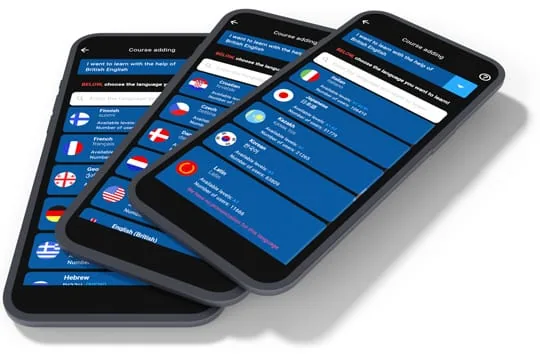
Discover the joy of language learning with Qlango! Our innovative platform offers a wide range of languages for you to explore, including Afrikaans, Albanian, Arabic, Armenian, Azerbaijani, Basque, Belarusian, Bengali, Bosnian, Bulgarian, Catalan, Chinese (Cantonese), Chinese (Mandarin, Simplified), Chinese (Mandarin, Traditional), Croatian, Czech, Danish, Dutch, English (American), English (British), Esperanto, Estonian, Filipino, Finnish, French, Frisian, Galician, Georgian, German, Greek, Hausa, Hebrew, Hindi, Hungarian, Icelandic, Igbo, Indonesian, Irish (Gaelic), Italian, Japanese, Kazakh, Korean, Kurdish (Kurmanji), Kyrgyz, Latin, Latvian, Lithuanian, Luxembourgish, Macedonian, Malay (Jawi), Malay, Maltese, Norwegian (Bokmål), Persian, Polish, Portuguese (Brazilian), Portuguese (European), Romanian, Russian, Scottish (Gaelic), Serbian, Shona, Slovak, Slovenian, Spanish (Mexican), Spanish, Swahili, Swedish, Tajik, Tamil, Tatar, Thai, Turkish, Turkmen, Ukrainian, Urdu, Uyghur, Uzbek, Vietnamese, Welsh, Xhosa, Yoruba and Zulu.
Start your language learning journey today!

We encourage you to answer in your target language only. Don’t worry, we have a hinting system, that will help you.

Spaced repetition is scientifically proven way of memorizing new material. You have to repeat it in 1, 2, 4, 8, 16 and at last in 32 days any you will remember it forever.

With them you will understand and be able to lead every day conversation.

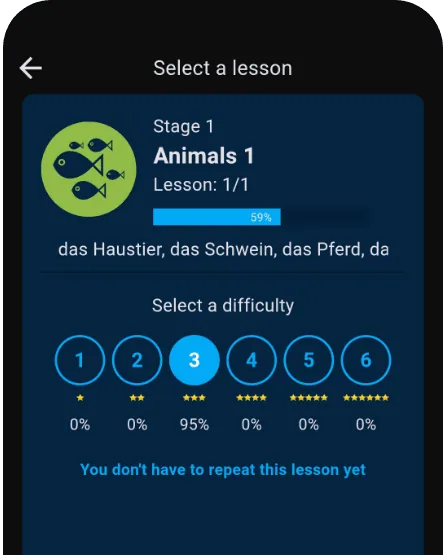
We are suggesting you which difficulty you should take next, but you can select your own.
Qlango is designed more like a game compared to other similar programs. We all like to play and with Qlango we learn by playing.
Qlango is designed not to waste time answering in a language you already know. You only answer in the language you are learning.
If you click on the number of the word, Qlango will read just that word and not the whole sentence. This helps us to distinguish one word from another.
At Qlango we emphasize gender of the nouns in German (later on also in Italian, Spanish, and French etc.). This means when we learn a new noun we also learn its definite article (e.g. die Frau) and memorize the gender. Other programs do not offer such option. Those who have ever learned one of these languages know that learning noun’s gender is quite difficult, especially when you already know the word.
With Qlango you only learn words and examples that consist only of words from that particular level (e.g. A1). This was one of the main goals of Qlango, since other programs teach words from higher levels at the beginning, which is confusing to the user.
Some other programs approve our answer even though it is wrong. With Qlango the answer has to be correct. If we do not know the answer, there are hints to help us guess it. Even when a hint shows all the letters of a correct answer, we still need to write down the answer in order to learn. Also, all the questions for which we needed at least one hint will reappear for so long until we answer the question without a hint. None of the programs that we tested does that.
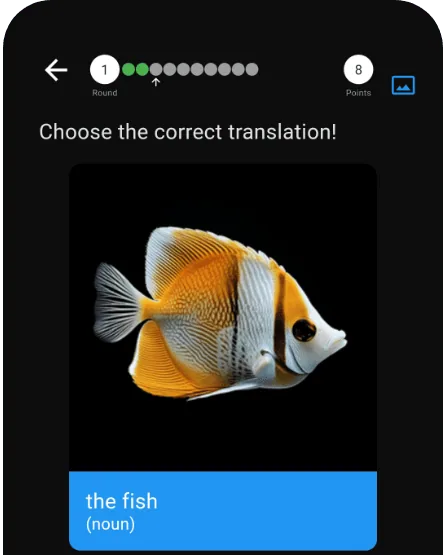
With Qlango we can choose whether we will learn just words or words with examples, and the manner of answering the questions (find 1 right answer among 4, formation of sentences, writing an answer by dictation, translating into foreign language, find pairs). That way each user is able to set the program according to their needs, since we all learn differently.
With Qlango you can set a weekly plan which enables you to regularly control your progress. Majority of other programs do not have such plans or the plans are on a daily basis. These programs penalize you after just one day without studying. With us you do not have to study at all for a day or two, but you need to compensate later to achieve your weekly plan. We all know there are days when you are simply unable to study.
After several years of using a few different language apps with varying levels of satisfaction, I am glad to have found Qlango as I think it covers most of the learning areas in a progressive way. It breaks down the building of vocabulary in a smart way too which is not too repetitive but still recurring enough to acquire active vocabulary. Well done!
This app is actually worth my time. It has helped me learn the Croatian language fast and efficiently. The lessons are well organized. The app teaches vocabulary and grammar which is very helpful. The only thing I could point out that needs improving is the way the words are pronounced. Other than that, I will continue using it.
It’s a very efficient, practical and fun app for learning new languages and broadening your horizons or just revising the already acquired knowledge. New words and phrases are easy to remember due to diverse gaming options and modes of playing. I most definitely recommend it to anybody who wants to improve foreign language skills, and it is also a very good way of re-learning a language that you used to or had to know while you were in school and have forgotten about it. My German isn’t that bad after all.
This is the first language learning app that I’ve found, where you don’t have to start with the absolute basics if you have some previous knowledge. The words/phrases are given within their usage context, so you’ll improve your passive vocabulary as well.